The fishing village of Ouchy was incorporated into Lausanne in the mid-19th century. The Lausanne Train Station, which was built between 1911 and 1916, forms the border between old Lausanne and its new district of Ouchy. In 2008, Métro Line 2 (M2) opened, replacing a funicular and track railway system known as “la Ficelle” (the String) that dated back to 1877. It heads 3.7 miles/5.9 km uphill from Ouchy to the Gare de Lausanne, on to the Old Town, and beyond to Sauvabelin Park above the Old Town. If you are staying in Ouchy, as we did, it makes getting around Lausanne a breeze.
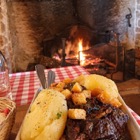
Another day, we took the M2 métro to Parc Sauvabelin, climbed up the Tour de Sauvabelin (a wonderful structure that is 115 feet/35 meters high and is entirely made of wood) to admire the view of Lausanne and the lake below, stopped for a traditional lunch at the Chalet Suisse (a typical Swiss chalet that was built for the Universal Exposition of 1958 in Brussels, dismantled after the fair, and reassembled in the Parc Sauvabelin). We then walked downhill all the way through the Old Town to Ouchy, a distance of only 2.25 miles/3.6 km.
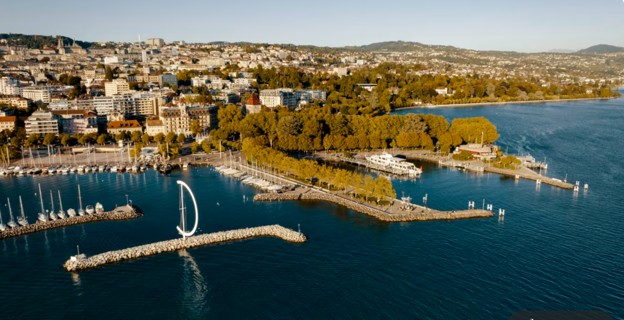
We lived it up and stayed at the magnificent Beau-Rivage Palace in Ouchy overlooking the lake and only 200 yards/meters from the Ouchy stop of the M2 métro line and 500 yards/meters from the CGN ferry terminal. Ouchy is the departure point for a fleet of vintage paddle steamers that connect Ouchy with other Swiss cities and towns on Lake Geneva, as well as with Évian-les-Bains on south/French side of the lake, directly opposite Ouchy. One day we took the ferry from Ouchy to the very atmospheric Château de Chillon, which was built by the Dukes of Savoy mostly in the 13th century and is well worth a visit. After exploring the château, we walked 10 minutes along a footpath to the Veytaux train station, where we boarded a train for the scenic hour-long trip along the lake back to Lausanne.
Lausanne bills itself as the Capitale Olympique since the headquarters of the International Olympic Committee are located in the new (2019) Olympic House in Vidy, just west of Ouchy. The Olympic Museum, on the other hand, is located right next to the Beau-Rivage Palace. The museum was built in 1993 and renovated in 2013. It tells the history of both the ancient and modern Olympic Games and is the most visited museum in Lausanne. Watching the film about the Opening Ceremony of the Olympics over the years, celebrating competition and good sportsmanship between the nations of the world, is sure to bring a tear to your eye. Standing next to the high-jump in front of the museum, with the cross bar set at the world record height for men, is a humbling experience. (I couldn’t even touch it with my hand when I jumped up, and some guy jumped over it.)
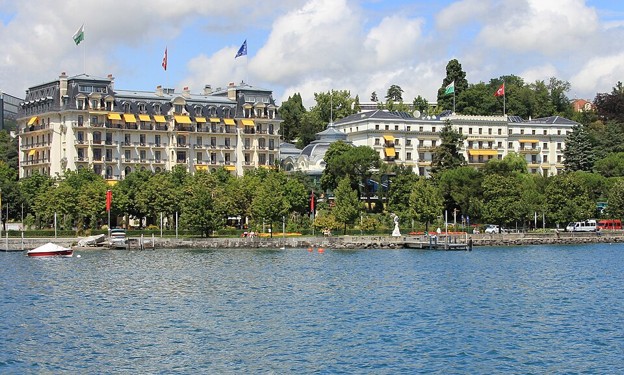
But it must be said that the aptly-named Beau-Rivage Palace was the highlight of the trip. The Beau-Rivage Palace is owned by the Sandoz Family Foundation, founders of Sandoz AG, now Novartis. The Sandoz Family Foundation also owns the two other grand hotels in Ouchy, which are only a short stroll from the Beau-Rivage: the Hôtel Angleterre and the Château d’Ouchy.
We don’t make a habit of staying in “palaces”, but the Beau-Rivage was, as they say, hors catégorie – in a class of its own. The hotel has a fabulous view of the lake and the Alps of Haute Savoie in France on the far side. The public areas of the hotel are grand, and the rooms are spacious and comfortable, equipped with the latest technology (it took us a while to figure out how to turn on and off the lights and to pull the shades). There are three restaurants, including the two-Michelin-star “Pic” (named after the French chef, Anne-Sophie Pic), which were always fully booked. A fancy spa. And a wonderful garden which featured 107 trees of 35 different species. (A guide to them was in our room.) The staff was incredibly helpful and friendly. And young. I suspect many of them had just graduated from the EHL Hospitality Business School, formerly known as the École Hôtelière de Lausanne, which was founded in 1893 by one of the first directors of the Beau-Rivage Palace, and is the oldest hotel school in the world. All a short stroll from the splendid half-mile/1-km-long promenade that was built along the lake in 1901, the ferry terminal, and the M2 Métro.
There is one big caveat: Switzerland in general – and the Beau-Rivage Palace in particular – is not for the budget traveler. But for a special occasion, it’s the bee’s knees.
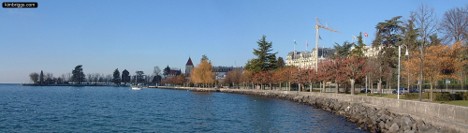
While reading Baudelaire’s Les Fleurs du Mal (1857) at sunset on a rock on the banks of Lake Geneva*, I came across his poem L’Invitation au Voyage and paused at the following refrain about his ideal destination:
Là, tout n’est qu’ordre et beauté,
Luxe, calme et volupté
There, all is order and beauty,
Luxury, peace and pleasure
Perhaps Baudelaire had a place like the Beau-Rivage Palace in mind when he penned those words.
Russell
* Not really.
 ← Previous: Chez Baillagou