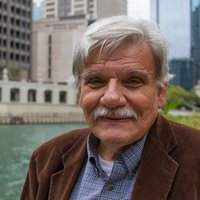
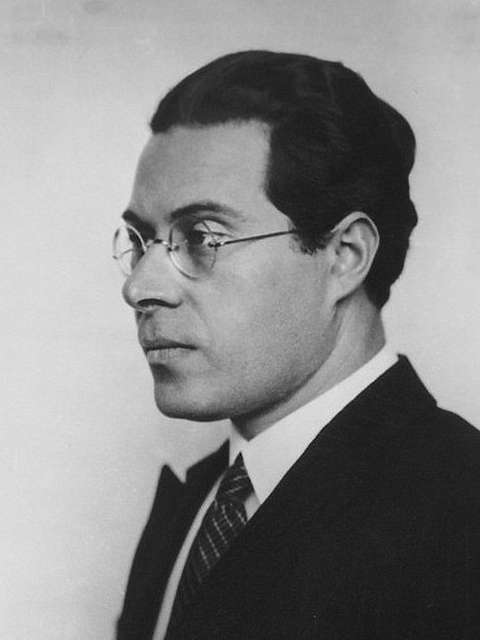
Chicago-based photographer Yuichi “Eugene” Idaka (1914-2012) was born in Seattle to immigrants from Japan, and spent his childhood between the U.S. and Japan. In 1928 Idaka moved with his family to Chicago, and attended Hyde Park High School. After high school Idaka enrolled at The University of Chicago where, in 1937, he graduated with a degree in Chemistry. During 1942-1945 Idaka attended the New Bauhaus school, studying under multimedia artist and educator László Moholy-Nagy(1895-1946). Moholy-Nagy, who escaped the Nazis and moved to Chicago in 1937, founded the New Bauhaus, an experimental school of visual arts that integrated art and technology. In 1945 Idaka completed his art and design classes, worked as a photographer in the city, and was also hired by Moholy-Nagy to teach film and photography at the New Bauhaus. Idaka and Moholy-Nagy became close, often deliberating modernism, aesthetics, photography, and technology. Moreover, both lost parents at a young age, and experienced political danger (the anti-Japanese sentiment in the 1940s, and the Nazis in Europe). Moholy-Nagy, who was older than Idaka by nineteen years, encouraged the young photographer and was a source of influence and inspiration.
In 1951, a few years after Moholy-Nagy’s passing, Idaka was chosen to be in a groundbreaking group exhibition at the Museum of Modern Art (MoMA,) in New York. Entitled “Abstraction in Photography,” the exhibition showed photographers who employed the medium in creative paths. Idaka’s abstract work was exhibited with famous photographers that included Moholy-Nagy. Through the years Idaka became known for his architectural and interior design photographs. In 2023 Higher Pictures gallery in Brooklyn, New York, presented an exhibition about the duo entitled “War Bonds: Yuichi Idaka and László Moholy-Nagy, photographs from 1925 to 1946”.
Currently in Evanston, The Block Museum of Art at Northwestern University (The Block,) is presenting an exhibition entitled “Picturing the Modern Metropolis: Prints and Photographs from The Block's Collection”. The group exhibition is showing more than one hundred prints and photographs from The Block's collection, focusing on 20th century modern works. Artists include Robert Rauschenberg, Ed Ruscha, Edward Steichen, Andy Warhol, and more, together with Chicago-based Yuichi Idaka, Henry Simon, Vivian Maier, and others. Each work examines the urban landscape, its sounds and visual effects.
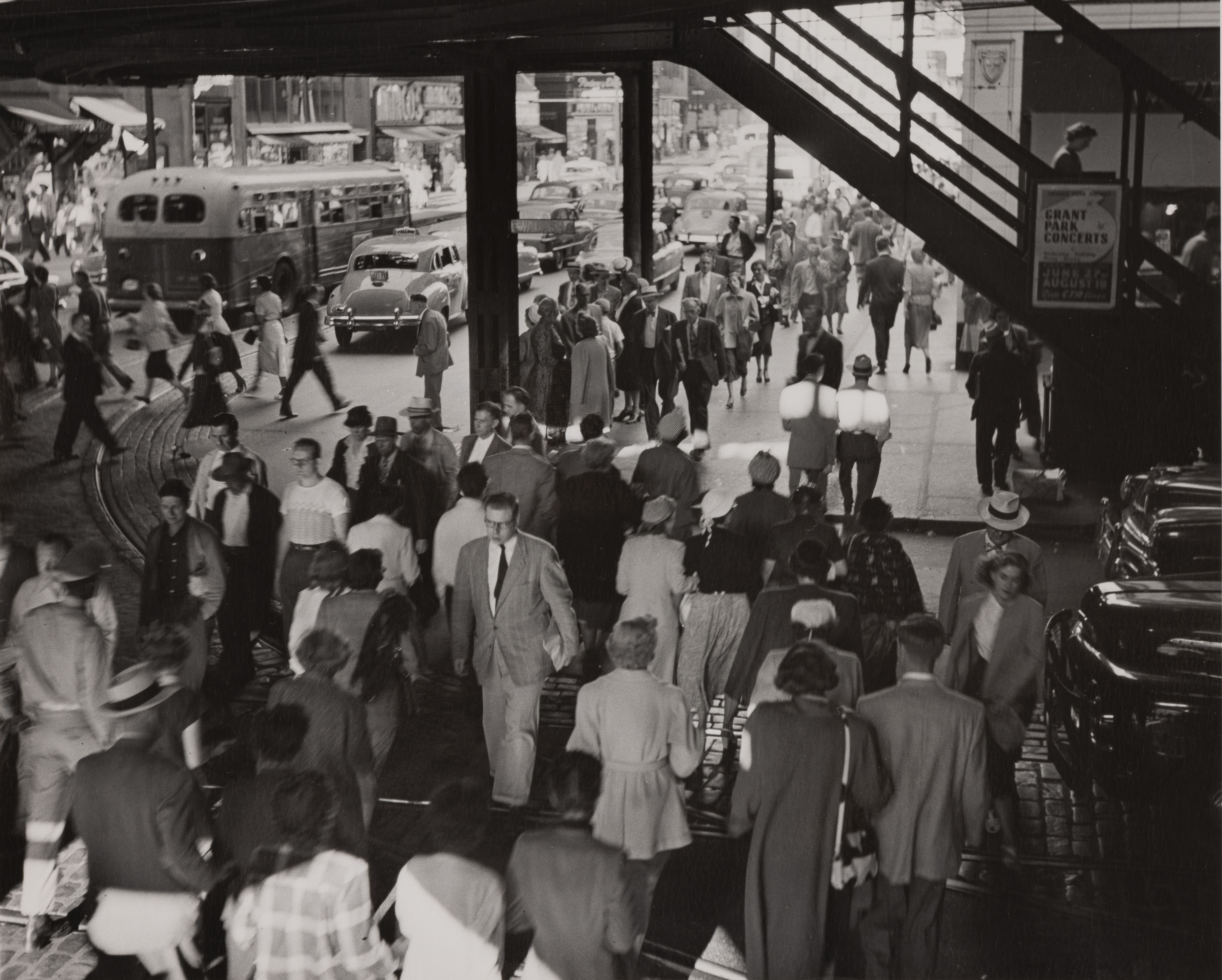
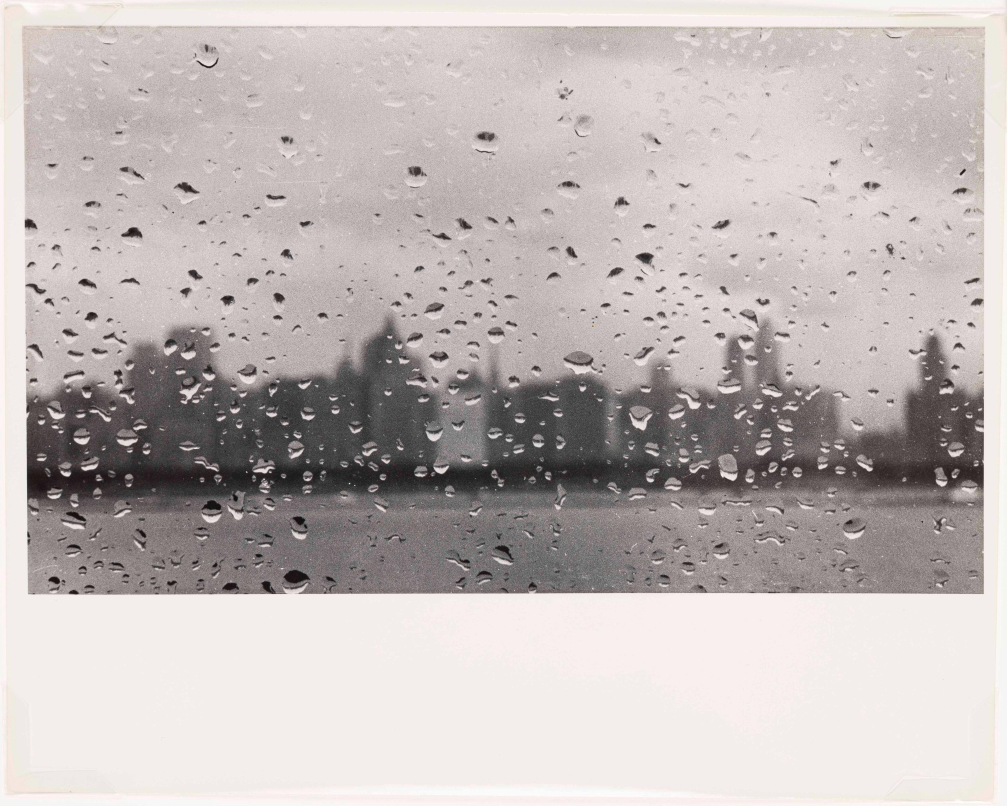
At The Block viewers could see several of Idaka’s innovative photographs. One of the photographs, “Untitled,” taken around 1946, depicts a crowded scene in a downtown Chicago street. The staircase connected to the “L” stop becomes the center of the image, and the structure’s geometric shape is architectural and modern. Another one of Idaka’s photographs is rectangular and more abstract. “Untitled” from the 1940s shows a foreground of raindrops on a glass window, and faintly in the back, there is a body of water with an urban skyline that sets the mood of a city on a rainy day.
Polish-born American artist Henry Simon (1901-1995) was based in Chicago. Simon initially expressed his art through various media that included illustrations, mural projects, paintings, and drawings. Years later, following his extensive art experience, Simon turned to photography, and in 1973, The Art Institute of Chicago exhibited “Photographs by Henry Simon”.
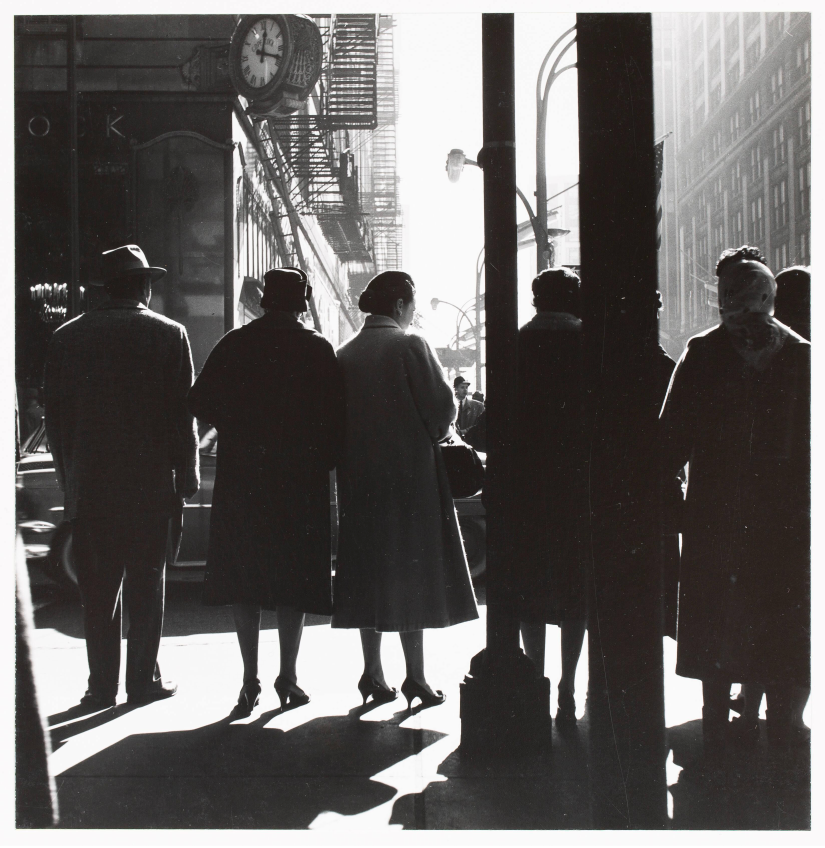
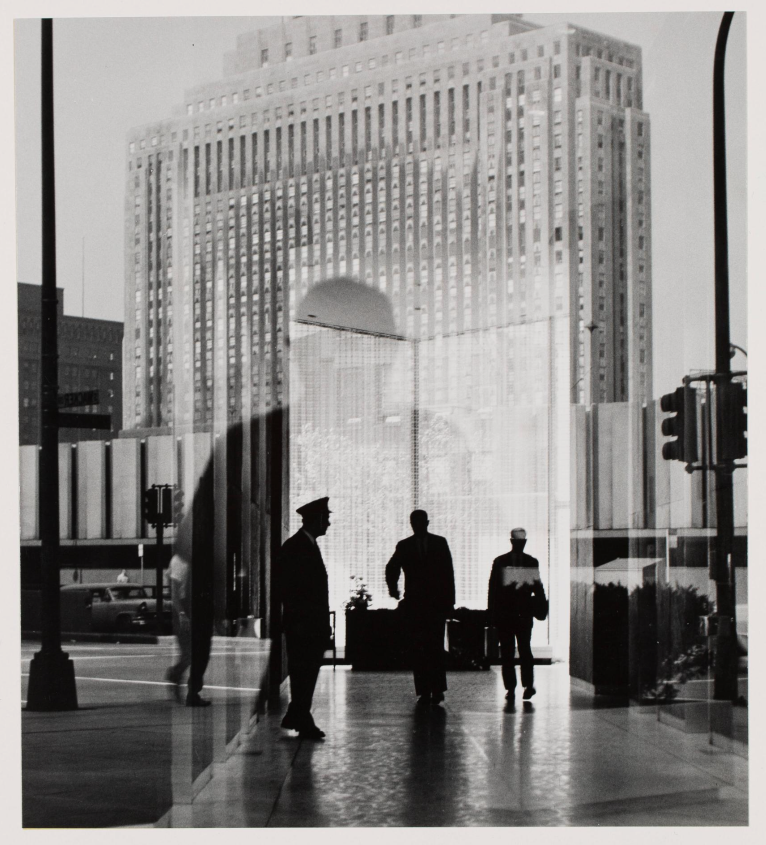
On view at The Block are multiple works by Simon. On one of the walls we view a captivating play of shadows in “Untitled (State and Monroe Streets,)” taken around 1965. Simon captures a moment in time where busy downtown Chicago becomes a theater of lights and silhouettes. Simon creates an urban drama, attained by anonymous figures, that invites viewers to explore the image. In a different photograph, “Untitled,” (Wacker Drive and West Madison, old Chicago Daily News Building,) taken around 1960, Simon focuses on architecture. The Art Deco building from 1929 represents a visionary point of view in Simon’s work.
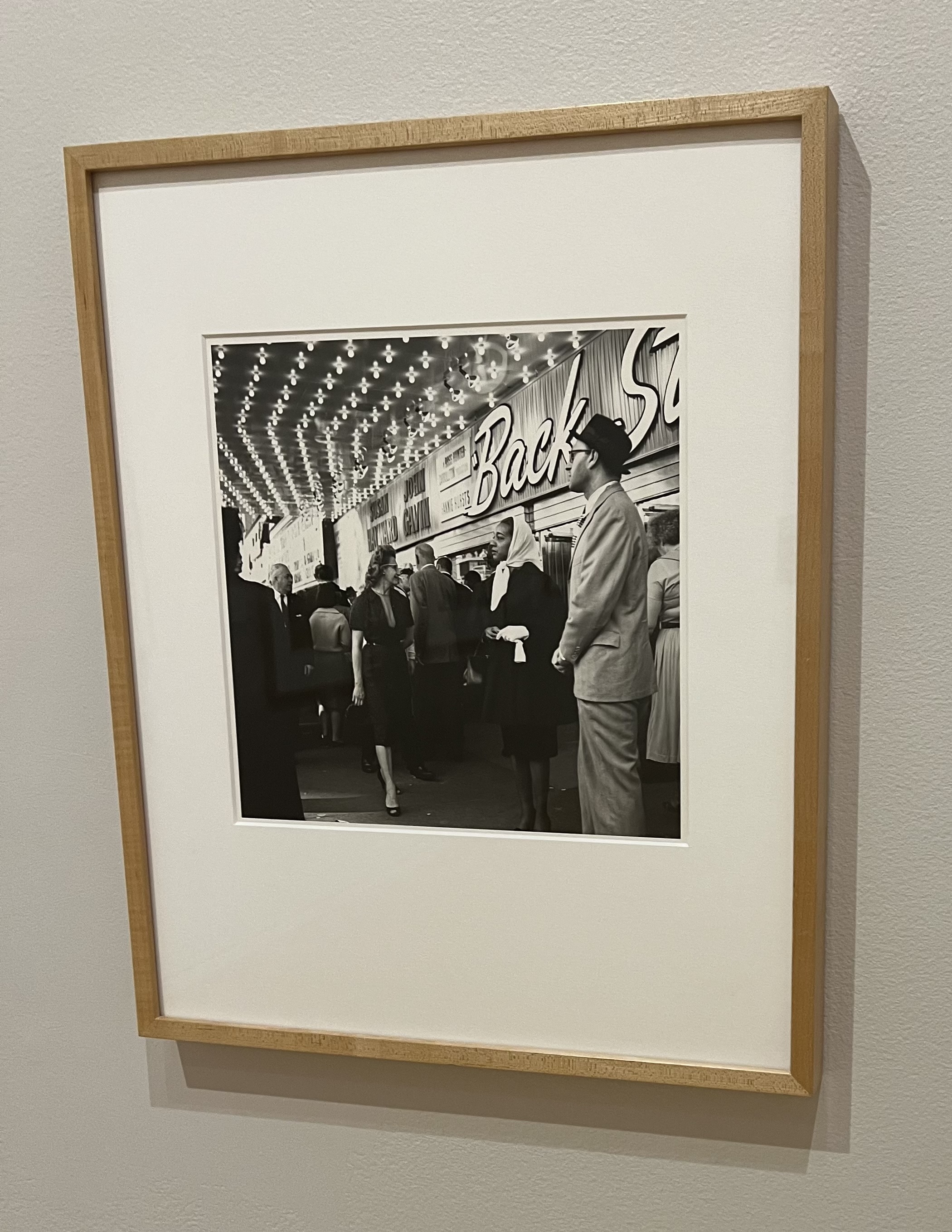
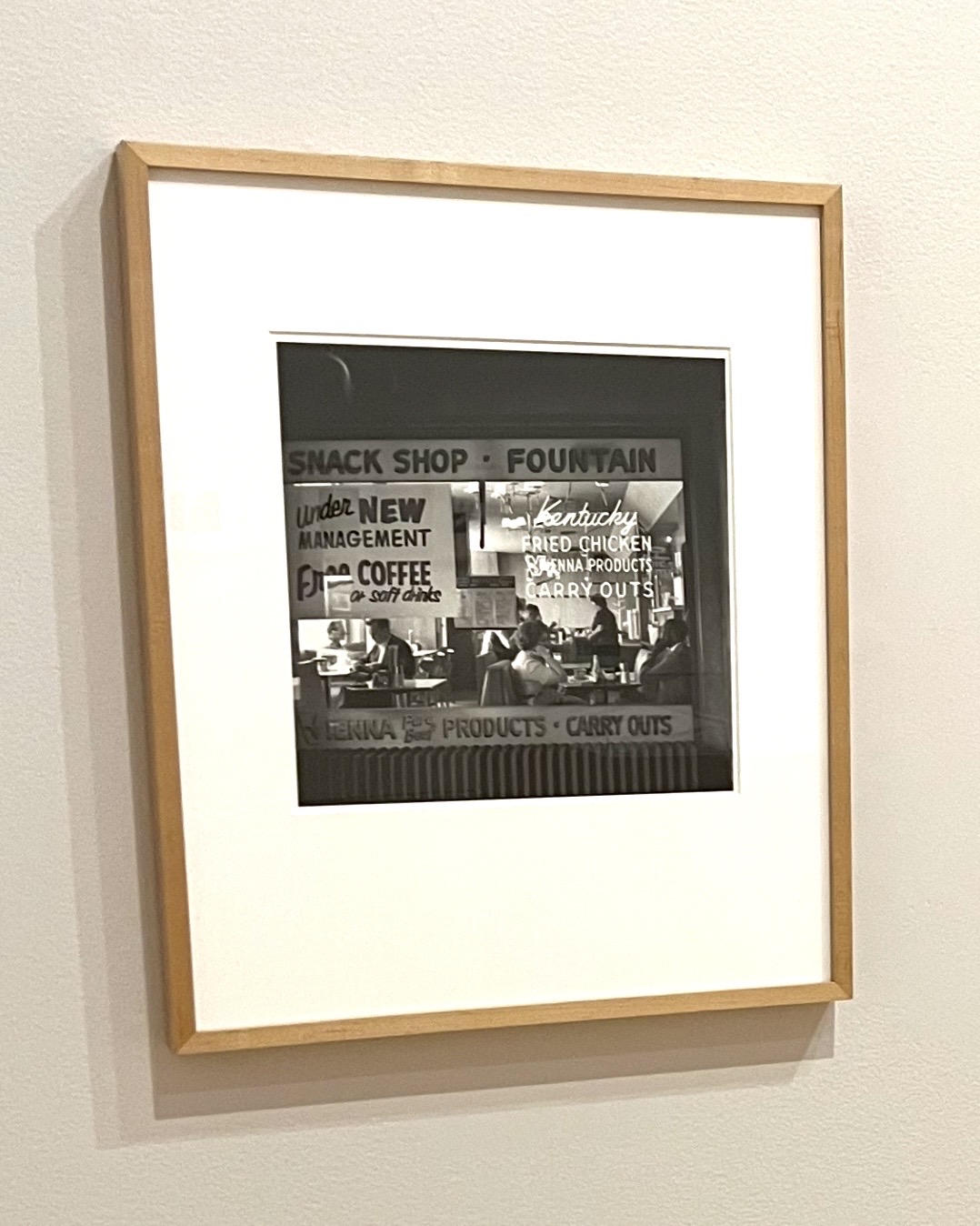
The exhibition brings to light works by self-taught photographer Vivian Maier (1926-2009). In one of the photographs we see Maier’s focus on the urban movie theater, and on the crowd outside the venue. The photo, “At the Balaban and Katz United Artist Theater, 1961, Chicago, IL,” printed 2024, shows the crowd under the theater’s illuminated marquee. Viewers of the photograph could see an elegant woman standing in the foreground, while the crowd scene displays urban vigor. To the left of the photo, we see another one by Maier, entitled “Chicago, IL, 1962” printed 2023, also known as Snack Shop & Diner. The image of a busy diner is captured through a large glass window. Viewers see diners seated at tables, signs that read “Snack Shop Diner,” and “Vienna Beef Products,” advertisements for “Free Coffee,” “Kentucky Fried Chicken Carry Outs,” and other banners. Maier creates a vibrant picture of everyday city living.
In addition to prints and photographs, viewers could enjoy a remarkable short film that is screening at the exhibition. Photographer Paul Strand (1890-1976) and multimedia artist Charles Sheeler (1883-1965) created the first American avant-garde film in 1921. Entitled “Manhatta,” the silent film presents a day in the life of lower Manhattan. Fascinated by the cityscape and the design elements Strand and Sheeler opt for sharp camera angles to portray New York's energy.
“Picturing the Modern Metropolis: Prints and Photographs from The Block's Collection,” is curated by Eduardo Bello, 2025-26 Interdisciplinary Graduate Fellow, and Corinne Granof, Academic Curator at The Block. The keynote conversation is happening at The Block on Wednesday, September 30, 2026, 6-7:30 pm, and professor Greg Foster-Rice will explore images and themes from the exhibition. For more information regarding the exhibition and related events you can go to https://www.blockmuseum.northwestern.edu/exhibitions/2026/picturing-the-modern-metropolis.html
The exhibition runs through Sunday, December 6, 2026.
 ← Previous: Baseball and Ulysses