
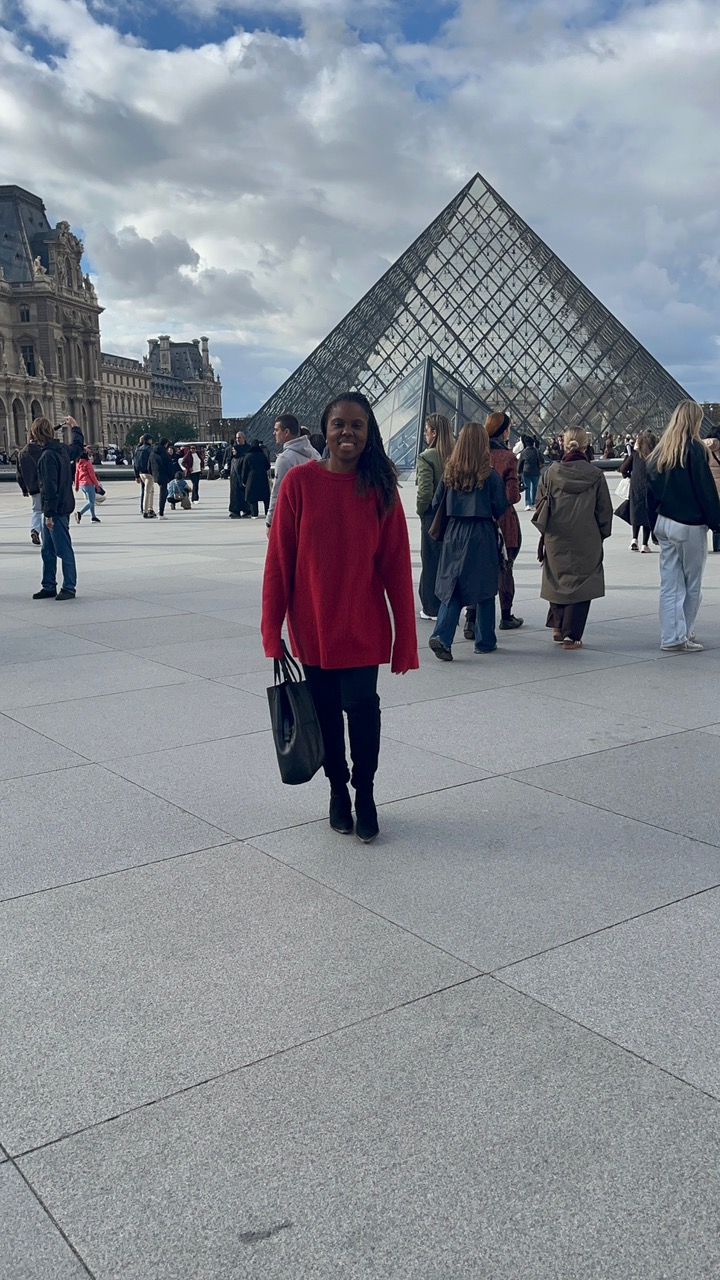
Chicago has been at the center of curator and educator Professor Asha Iman Veal's career. She has taught at the School of the Art Institute of Chicago since 2017, and while her work has taken her around the world, recently she added a new city to call home: Paris. Now splitting her time between Paris and Chicago while pursuing her doctoral studies, Veal joins us to talk about what drew her to France, how living in Paris has changed the way she sees her work and the world, and how her connection to Chicago continues to shape her life when she is across the Atlantic.
Dr. Rob Murphy: Before we get into your life in Chicago and Paris, can you tell us a little bit about where you were brought up and what experiences or influences early in your life helped shape the person you are today?
Asha Iman Veal: I was born and raised in Sacramento, California, in pockets that were a very loving community. When I go home, there's a canal in our neighborhood where people go for long walks. When you walk, you say good morning to everyone you. When you pass someone else taking their morning walk, you put up your hand, wave, and say good morning. That's my home.
I did my undergraduate studies in New York City at New York University’s Gallatin School of Individualized Study. Most of my classes were at Gallatin, where it could be described as a liberal arts curriculum. I also had many classes at NYU’s Tisch School of the Arts. When I started undergraduate school, I wanted to be a print journalist. I was quite often in that department as well. This was the early 2000s and I had already written for my home city's newspaper, The Sacramento Bee, as a teen columnist. Eventually, I did an internship at the Sacramento Business Journal as a fact checker and then was promoted to a staff assistant, while I was still in high school. At that very early time in my life I wanted to learn all about media. I did several internships in New York: at MTV in their original programming and series development department; as a junior reporter for the Staten Island Advance; and as an intern for Time Out New York for a brief period. My goals at the start of university were very different than my dedications near the end.
My focus began to lay in two places: one is working with arts and advocacy, and the other was looking at global arts ecosystems through study abroad intensives. In my sophomore year, I was able to legally go to Cuba as part of a course at Tisch. During the semester, we would be in New York which included listening to guest speakers, reading a lot of texts, and learning about histories of their Revolution through an artistic lens. At the end of the semester, our group of 25 students all traveled to Cuba for two weeks. Our group’s program there was the same thing I do in my career often now, where we wake up at 9:00 a.m. and see five arts institutions during the day. It’s quite tiring by the end of the day, but by the end of a concentrated period of time, you will have seen everything you could possibly see of the art world in a specific place.
Dr. Rob Murphy: You also had an important experience in Vietnam just as you were finishing college. What happened there?
Asha Iman Veal: In my senior year, I went to Vietnam as part of a similar course where we studied the Vietnam War—we learned that in Vietnam it is referred to as “The American War”. We spent the semester with two veterans: one a filmmaker, the other a writer. Then as a group we produced a documentary film. My role was in research, not technical production or directing. By this point, I’d begun repositioning myself as a creative writer, and had moved away from wanting to be a news journalist. Through the opportunities I in New York and working with different artists, I fell in love with narrative nonfiction storytelling where one can take narratives and put them into fiction to bring the story to a broader audience.
While I was in Vietnam ending this semester course and literally just graduating, I was with one of our instructors who is at least 40 years older than me. We were in a small fishing town, just walking through doing site research, and a lot of the young women started coming up to me. I did not think anything of this—they were touching my skin, touching my hair, and talking to me. Most people did not speak English, and I don't speak Vietnamese. Some women could say a little bit of English and would ask, ‘Is that your husband?’ I was confused because I was 21 and this person, my instructor, was much older. I kept trying to communicate, ‘No, it's not my husband. I'm a student and have come to work on this project.’
We eventually left the girls, and the instructor looked at me and said, "What do you want to do now that you have just graduated?" I replied, "I'm a writer and have studied to be a writer, and this is what I'll do." He said, "No, you won't." I felt really annoyed and asked, “What do you mean, No I won't?” He said, "You like people. You're not going to have a life where you sit by yourself all day. Writers have to sit by themselves in front of a typewriter or computer. You're not going to have that life." I didn't understand what he meant until I got older and could think back to that moment. Today I can realize that probably most people would not have let strangers touch their bodies, touch their hair, and try to talk with them when they don't even speak the same language.
Dr. Rob Murphy: Looking back, how did those experiences lead you toward the kind of work you do today, and eventually to Chicago?
Asha Iman Veal: I built my chops in New York, repetitively learning how to go somewhere, learn a different arts culture, talk to people, and be comfortable wanting to communicate and have everyone understand each other.
I did my MFA in creative writing also in New York. I didn't know that I would leave that city until...sometimes they say New York's one of those places where you love it until you don't. When I was done, I was really done. I ended up moving to Chicago in 2007, where I knew two people. At the time, I had been thinking of moving to London. I didn't know at 25 years of age that it's very difficult to just say, ‘I'll get a job in London.’ So, I moved to Chicago and it seemed like the life that would be right for me at the moment, and that's how I got here.
Dr. Rob Murphy: That's quite a trajectory. Tell me about curatorial practice. I’m not sure what that even means, so please tell me.
Asha Iman Veal: I love this question. It is what I teach at the School of the Art Institute of Chicago (SAIC). Even being in Paris now—I used to teach a 3-3 course load at SAIC, so three in the fall and three in the spring; now I only teach in the summer. When I teach curatorial practice, the way I start off with undergrads, the first thing I say to the students is if someone tells you being a curator means you hang a flat artwork on a wall because it’s ‘pretty,’ they've lied to you. That is not what we do. Some people think it is, but it's not. Curatorial practice is a creative collaboration so you can have a public discourse through the arts that you could not have anywhere else in any other way. If we think about the ways that ideas are communicated through the news or all the ways we expect to find information, for me art spaces are a place where you can do that thing that does not happen anywhere else. You do it in collaboration with artists for the public wanting to have that type of dialogue.
Dr. Rob Murphy: How do you bring different artists and ideas together to create that kind of conversation?
Asha Iman Veal: A way I think about curatorial practice is from an essay I teach by two scholars—Irit Rogoff and Beatrice von Bismarck, in the U.K. and Germany respectively—who have written a lot of literature about this topic. They talk about constellational theory as well as what it is to create new sources of knowledge. In constellational theory, it is the same as constellations in the sky: there are stars, and through them we have some sort of imagery remaining with these things that already exist. Through curatorial practice, it is the same thing. Maybe there are ideas, concepts, or images that we have familiarity with, but you're bringing them together in a new way to create a different picture or understanding for people.
Dr. Rob Murphy: I understand that you create exhibitions. Can you describe what that really entails?
Asha Iman Veal: I love creating exhibitions, studying them, and seeing the exhibitions of other arts and culture workers. Something in Paris that I have re-fallen in love with is the single-artist museum. If we go into a museum, sometimes you see a monographic exhibition: it is one artist, all their works from a particular project or time, and we're learning about the ways they see the world, the political places they have inhabited, their material practice, how they make images, and how they see.
There is also the ‘group exhibition,’ which brings together however many folks you want. Sometimes it's thematic, sometimes chronological or art historical. When you are a curator, depending on the type of artist you are working with and the venue—whether you are on staff or freelance—you are thinking, ‘How do we create a constellation or a narrative through images that the public can physically walk into?’ They can become part of a story or history, expand their thinking, or find emotional attunement. How do we have a space where people can come in, feel that they belong, and know there is space for them? You do that through working with artists.
Also, the format changes depending on the type of place the exhibition will take place. If it’s a museum, art center, or biennial.
Dr. Rob Murphy: It sounds like a curator also has to build a tremendous amount of trust with artists. What are those relationships like?
Asha Iman Veal: I go on studio visits with different artists. Everyone does studio visits differently—it's like whatever dish your grandmother makes: everyone's grandmother makes a delicious dish, but it's always a little different, even for the same thing. As one can expect, all curators are different.
I had a boss, Allison Peters Quinn, who is now at the Elmhurst Art Museum and was previously at Hyde Park Art Center. I learned so much from her about how to do studio visits. Kate Zeller, who used to be at the School of the Art Institute of Chicago, was another early boss who introduced me to doing them. I tend to talk to people almost the way you and I are talking now, and start by asking, ‘Who are you?’ For me, it is always a unique relationship you have with artists when working on a project. I tend to prefer group shows because there are so many different people, and you figure out how to weave all their stories and personalities together. You are asking people to trust you with their work physically—and also trusting you with their dream for their life. So, I start studio visits with: ‘Who are you? What do you care about? How do you want this to go? How do you communicate? Who do you want to see your work on exhibition with? What matters to you?’ I'm also always thinking how can I write about your work because that is part of our job, too. Also, ‘These are the things I’ve been thinking about lately, and the thing hopefully a group collaboration can build together…”
So you are trying to see how you match in the moment or in the future. Sometimes you will have a studio visit, see their work, and pick up people right away for projects in progress. Sometimes it may be two years out, or even five years later. Those studios are sometimes independent, sometimes at art centers or studio blocks. A lot of people are resident artists who travel around the world and country, with studio spaces provided by different institutions, and curators are invited in.
Sometimes you commission new projects specifically for an exhibition. Sometimes artists have work they consider old, but it is phenomenal—it doesn't matter if it is 10 years old. Sometimes you pull things they were not thinking about in the same way to bring into a contemporary conversation. It is the person, the works, and really about how an audience comes through and feels something differently through this process.
Dr. Rob Murphy: You have traveled extensively around the world. You talked about Havana and Vietnam, but I also read that you have been to Tokyo and Berlin. Can you tell me what you were doing in those places?
Asha Iman Veal: I thought I would have a deep relationship with Tokyo and Berlin, and it turns out my deep relationship was with Paris. I went to Tokyo for the first time back when the internet had ticket glitches often. I went to Tokyo on a $300 ticket where you had to layover in Milan and Prague on the way. It was the best!
I went again in 2016 as part of my MA master's thesis. My thesis pitched a multi-site exhibition in Tokyo. I got pretty far in my planning, but unfortunately, I had a family crisis that summer and had to stop the project. By then, the timing didn't work anymore as my career started to take off in Chicago.
Around 2017, I was invited through the Chicago Council on Global Affairs to be part of the Pritzker Forum on Global Cities. A couple of months later, they asked if I wanted to join the BMW Foundation Transatlantic Cohort. It was a mystery at first. BMW invited me to be part of a cohort they were building on a remote island in Canada—Wasan Island—a place frequented for meetings by nonprofits. I showed up with two huge suitcases and three-inch heels, looking like Goldie Hawn in an 80’s movie overpacking because I didn't know where we were going. It was an intentional gathering of Germans and Americans run by a former German ambassador. Bringing together Americans and Germans was like a sister cities initiative to help people build friendships necessary for future leadership. I was the only person from the arts, and stayed with the BMW Responsible Leaders program since then. Because of that, I have a great group of German friends and started hanging out in Berlin before the pandemic. I thought I would move there, but when the pandemic hit, I stayed in Chicago.
Dr. Rob Murphy: After building so much of your life and career in Chicago and being on the faculty at the School of the Art Institute, how did Paris become your second home?
Asha Iman Veal: I sincerely think it was meant to be—a bit of destiny. I was supposed to move to London for my Ph.D., but it didn't feel quite right. I've wanted to do my Ph.D. and live in Europe for well over a decade, but the timing was never right. I was accepted to schools in London, and even put down a deposit but then didn’t go. Two days after my birthday, I was Googling different programs, and the University of London Institute in Paris came up. The application was due that same day. I sent in the application, and it all worked out. The international political environment of our campus is a fit for me and is how I have always worked in a way—at the intersection of arts and politics.
Dr. Rob Murphy: What has surprised you the most about living in Paris?
Asha Iman Veal: I thought I was solidly literate in French—that surprised me when I got there. I used to live with Francophones, I went to a French camp in Montreal when I was 19, and took French classes in Chicago in the early 2000s. I thought I could read and hear French, but when I arrived, it was like starting from scratch.
Also, my Southern family taught me manners that have helped me get around in Paris really well. My Texas grandmother always told me to cover my neck when the temperature drops. In Paris it is the same way. Even the mannerisms—walking into a shop, saying hello, looking people in the eye, saying thank you, acknowledging people, and being mindful of the space you take up out of respect for others—are what having Southern family taught me. I realized I knew exactly how to be there, even though I could not speak fluently yet.
Dr. Rob Murphy: I have seen French men wear scarves in July. Of course, that was in the past when there was an occasional cool summer morning, unlike now which is sweltering, but that’s another story. Now that you move between the two cities, what do you miss about Chicago when you are in Paris, and what do you miss about Paris when you are back in Chicago?
Asha Iman Veal: I have an addiction to the Whole Foods 365 Lime Popsicles (laughs). All summer I have eaten as many as I could, knowing the limited window I had to enjoy them. In Paris, I am addicted to the Naturalia brand of gummy bears. I'm sure you did not think I would answer this way! But seriously,
I miss the Luxembourg Garden in Paris when I am in Chicago. I have a habit of going there for an hour and a half in the morning or evening just to walk around. I had such a habit of being there every morning this past spring, and I have missed it so much this summer.
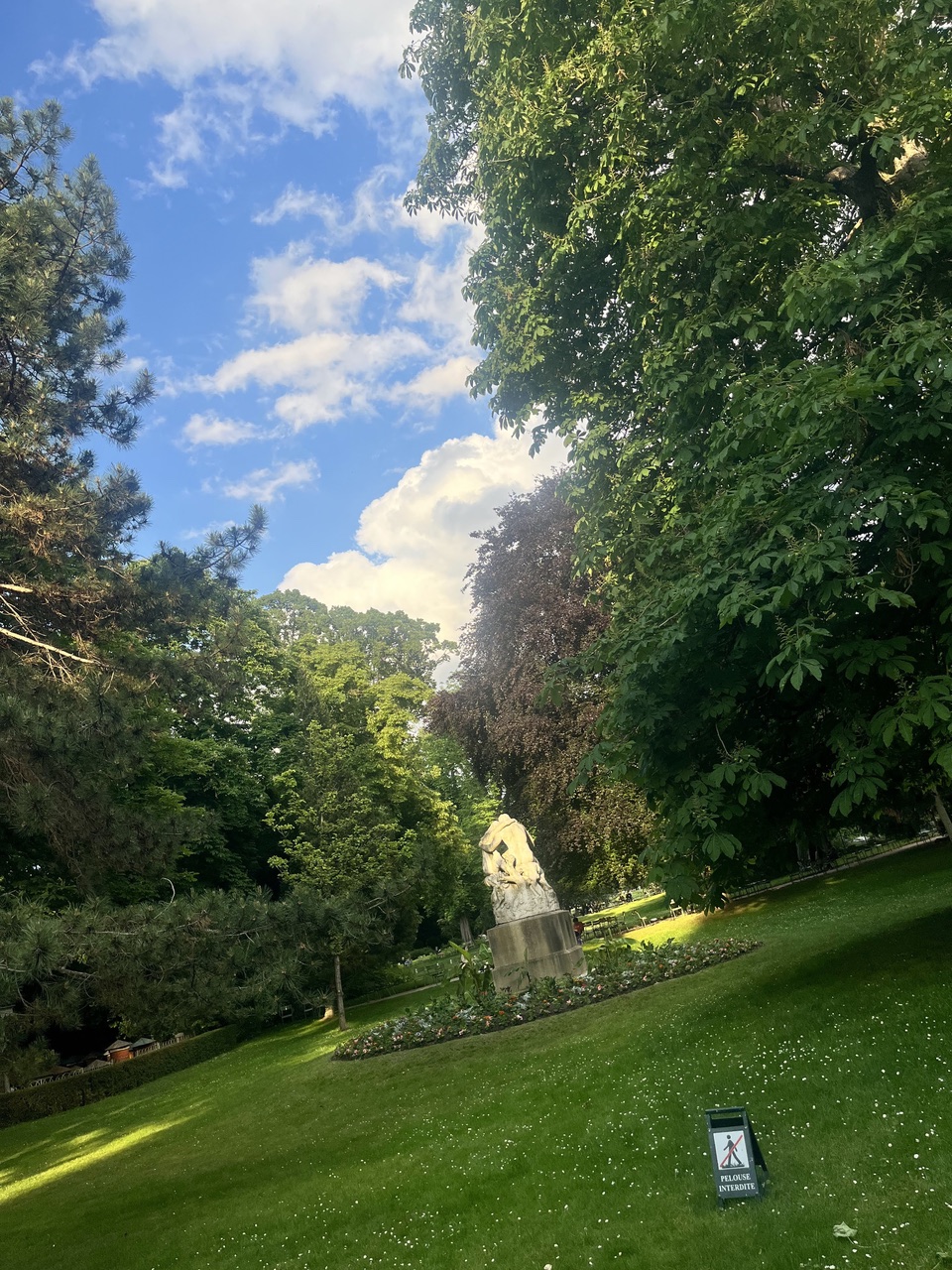
When I moved to Paris, I thought I could not live without being beside Lake Michigan, but it turns out I can, although I miss it.
Dr. Rob Murphy: Which neighborhood do you live in in Paris?
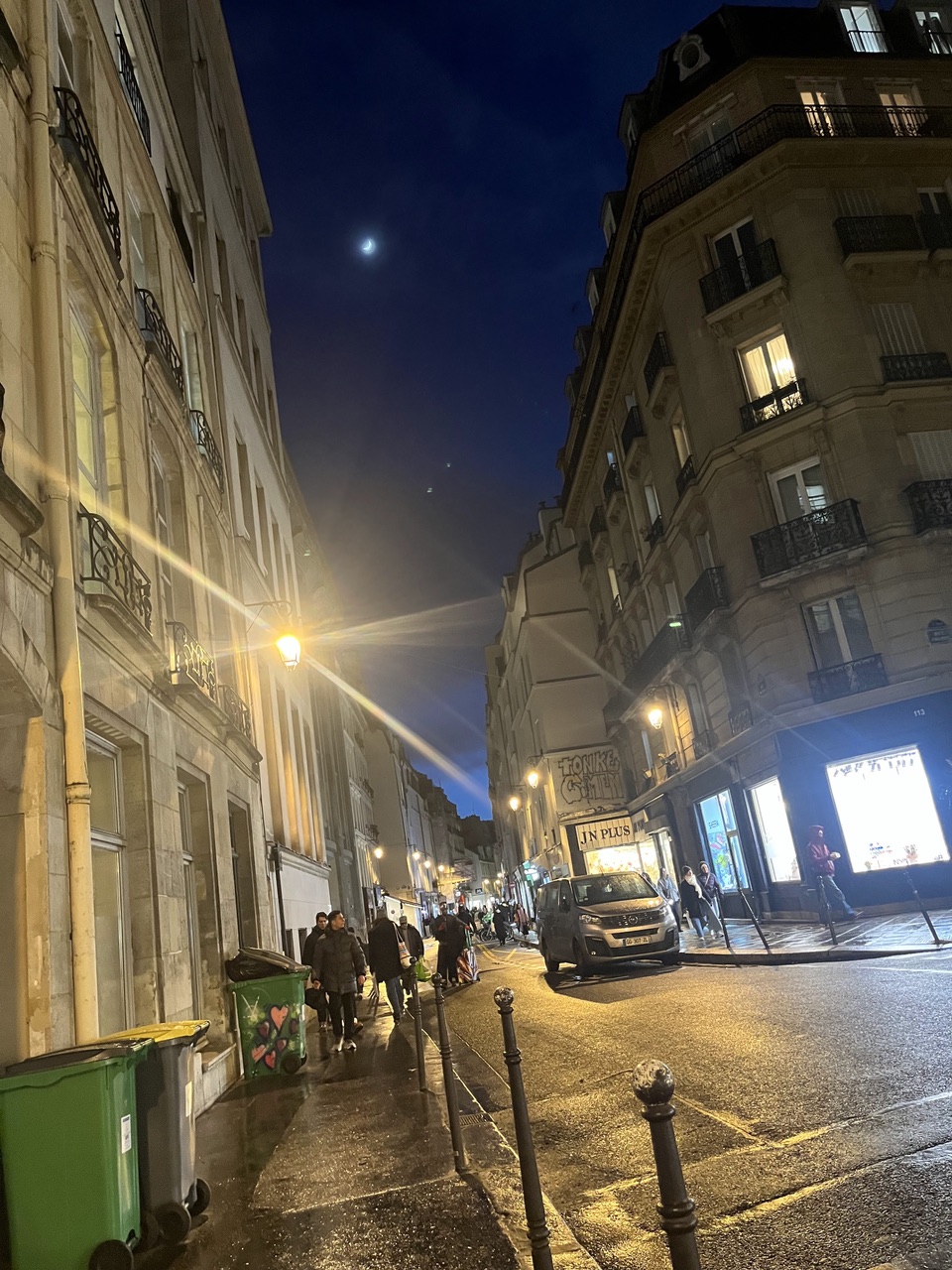
Asha Iman Veal: I live on a street that borders the 14th and 6th arrondissements, on the 14th side. It’s a great neighborhood and very French!
Dr. Rob Murphy: And now, my last question that I ask all my guests. If a friend comes to Paris for a brief stay, what three places would you recommend that they visit?
Asha Iman Veal: First, the Arab World Institute Library in the 5th arrondissement. It is silver, metallic, exquisite, seven stories tall, and right on the Seine. Second, join an outdoor dance party right across from the Arab World Institute along the Seine. On a spring or summer day, people play music and dance by the river, and you can just join in. Totally free and a lot of fun. And lastly, Luxembourg Garden.
Dr. Rob Murphy: Thank you very much for telling us all about your exciting life. Since the University of London Paris Institute is a five-minute walk from my apartment, I am sure I will be seeing you soon in Paris! Good luck with your graduate studies!
 ← Previous: Threads of Time: Remembering Ellen Stirling
 Next: The Season for Remembering →