
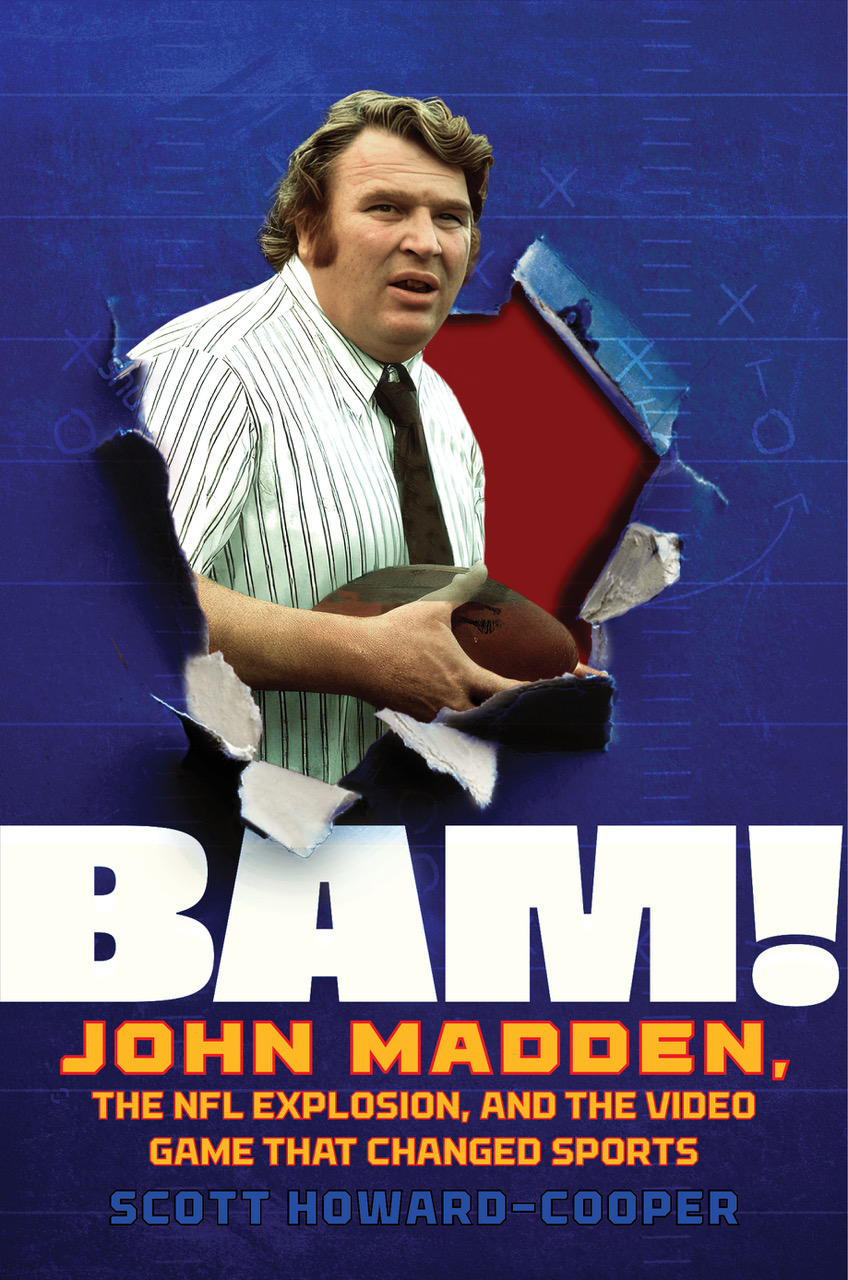
Almost five years after his death, a new book explores John Madden’s considerable impact on the National Football League during three completely different careers.
Written by longtime sports journalist Scott Howard-Cooper and published by Diversion Books, BAM! John Madden, The NFL Explosion and The Video Game That Changed Sports is a strongly researched biography of this beloved 6-foot-4, 250-pound head coach, broadcaster and video-game pioneer.

A head coaching prodigy at 32 when he was hired by Oakland Raiders owner Al Davis, a decade later Madden was beset by an ulcer, which caused him to vomit frequently. That’s when he witnessed his own defensive player, Jack Tatum, pulverize New England wide receiver Daryl Stingley during a hit in an exhibition game, leaving the 26-year-old paralyzed. Madden visited him in the hospital after the game and found no one from the Patriots there. He continued to visit, prompting Stingley to say later, “I can’t tell you the love I have for that man.”
That horrifying outcome contributed to the coach’s decision to retire at the end of the season – with 103 wins to his credit. Madden left behind legendary players from Cliff Branch to Ted Hendricks, who captured a Super Bowl with the Raiders soon after. Though reluctant to wear makeup and put on a jacket and tie as a broadcaster, Madden was persuaded to try it, given that in a few years he’d probably be forgotten by the networks for any television role.
Howard-Cooper makes clear Madden’s obsession with planning. He was frustrated by the lack of answers to his questions from CBS staffers concerning how to be a broadcaster. This was a man whose devotion to preparation was so thorough that his four-inch Raiders’ playbook contained a nine-point guide on the huddle (reprinted by Howard-Cooper), which includes “The center must be the first man to set up the huddle 8 yards behind the ball – HURRY!”
His first practice broadcast jarred him, as he had to sit high in the Los Angeles Memorial Coliseum to analyze a 49ers-Rams game rather than enjoying his sideline perch. But by his first real broadcast he was a natural, emitting a “Boom!” and making fun of himself, which always endeared him to fans.
He embraced stats (Howard-Cooper noted CBS added five staffers to its original one to chart stats for its star broadcaster) and pushed for shots of the offensive line engaging the defensive line so the former offensive tackle could discuss blocking. He enthusiastically met with coaches and players days before games (“I noticed that some CBS people thought that having a drink with the team’s public relations man passed for research. But that wasn’t enough for me,” said Madden in the book). During the players strike in 1982 when CBS, almost unbelievably, sent Madden and Pat Summerall to broadcast a Division III game on a Sunday because no NFL games were available, Madden gathered information from the coaches and players at two small Ohio schools before kickoff.
Madden eventually traveled in a custom-made bus – known as the Madden Cruiser -- because of a fear of flying. He stopped in small towns across America, eating pig-ear sandwiches and even attending a Mule Days celebration. Insatiably curious, he would pick up local newspapers and ask questions of residents in diners and wherever else he met them.
He also became the face of an Electronic Arts football videogame. And not just the face – he was determined to make it as realistic as possible, showing EA executives during the first 12 hours of an Amtrak jaunt in the 1980s that they needed to think about the weather, turf and other factors that influenced outcomes. The plays available in the inaugural seasons of John Madden Football came from Madden’s own Raiders’ playbook. Now known as Madden NFL, it has sold more than 150 million copies. Even those who became stars in the NFL learned from the videogame.
“It made you a better football player,” noted Hall of Famer Marshall Faulk in the book.
Not to be forgotten amid his multifaceted journey is Madden’s role as a Miller Lite pitchman during the glorious “Tastes Great! Less Filling!” campaigns. Writes Howard-Cooper, “Madden gladly embraced the image of the bombastic oaf, crashing through a prop brick wall made of paper…strangers would even approach him, fling their arms about, and recite his comical lines.”
BAM! is tightly written as one would expect from a former L.A. Times reporter, whose sports section was once among the best in the land. Surprisingly, one of the most fascinating entries occurs at the beginning and doesn’t even mention Madden, a future Hall of Famer.
After NFL Commissioner Bert Bell died of a heart attack in the stands during a Philadelphia-Pittsburgh game, owners suffered through 22 votes for the next commissioner without anyone receiving 75 percent (8 of 12). Then seemingly out of the blue, Wellington Mara and Paul Brown suggested Pete Rozelle, a 33-year-old public-relations man for the Los Angeles Rams who had never played the game. He won on the next ballot.
“There was no way to imagine as officials decamped from South Florida that the outcome would become a turning point in league history and among the most meaningful moments in American sports,” Howard-Cooper notes of the man who would rule the NFL for 29 years and guide football to preeminence among U.S. sports.
Beyond Bam!, there’s also a movie about Madden coming out on Prime Video Nov. 18. Unfortunately, Madden does not seem likely to score a touchdown with the audience. Nicolas Cage plays the coach/broadcaster/videogame guru, and in a trailer, neither his look nor his voice match the big man’s; it almost seems like a parody. At least we have Bam! for a riveting account of Madden’s life.
 ← Previous: Antiquarian Society: 150 Years of Building on Traditions
 Next: On Vocabulary →