The rules governing the most popular sports league in the United States always boost the worst teams and the smallest markets.
Consider: The Las Vegas Raiders, miserable in 2025 at 3-14, were rewarded with the top draft pick in 2026, along with an easier schedule -- a pair of victories for their ineptitude. Housed in the nation’s largest city, the New York Giants receive the same amount of shared national revenue – more than $450 million annually -- as the Green Bay Packers (population 100,000) and spend an equal portion on players.
Call it parity, competitive balance or socialism, the National Football League is dedicated to trying to ensure no team keeps dominating and that dynasties never materialize. That formula keeps fans engaged every week as tight games are common.
Then why do some franchises succeed year after year despite these obstacles?
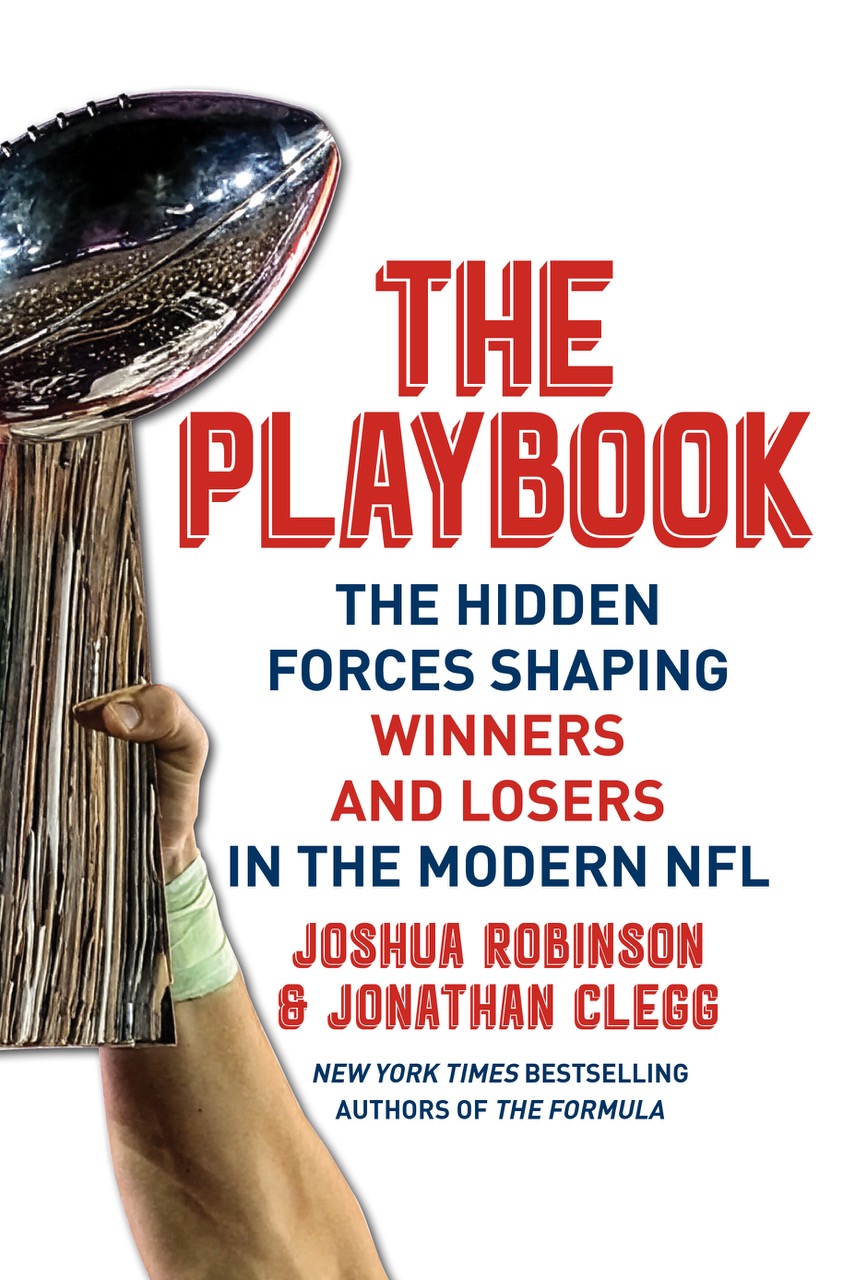
The Playbook: The Hidden Forces Shaping Winners and Losers in the Modern NFL, published by Mariner Books in September, tackles that question. Joshua Robinson and Jonathan Clegg, respectively the present sports editor and the past sports editor at The Wall Street Journal, examine winning strategies since the introduction of the salary cap during the 1994 season.
Despite their poor start this year, the story of the Los Angeles Rams comprises one of the most captivating chapters in the book. Sean McVay was only 30 years old when tapped as the team’s head coach. An offensive mastermind, he took over a franchise that endured 10 straight losing seasons and guided them to the Super Bowl within two years. That’s when General Manager Les Snead abandoned his whole strategy of building for the future.
The authors noted how during the next two seasons the Rams traded four first-round draft picks and six other draft choices for immediate contributors. Result? A Super Bowl win over the Cincinnati Bengals.
“Correctly identifying that you’re in a championship window is one of the hardest things to do in the NFL,” they wrote. “When the Rams won Super Bowl LVI, inside their home stadium in Inglewood, California, it constituted absolute vindication.”

Snead had concluded the draft – especially the first two rounds -- was not a panacea. Deciding what positions the team would “break the bank” for within the salary cap became a priority.
“The most important decision a front office could make wasn’t which rookies to select, or which pieces to trade, or which stars to court in free agency,” wrote the authors. “It was choosing which players received a second contract, the life-changing piece of paper that converted a cheap asset on a rookie deal into a major, multiyear financial commitment.”
Though today quarterbacks are often the prize picks in the draft – the ones most assume will earn that second contract -- general managers weren’t that enchanted by quarterbacks at the dawn of the salary cap. Consider drafts from 1994-1998: the authors pointed out the No. 1 overall pick featured five different positions, and only the last pick – Peyton Manning – was a quarterback (and what a quarterback).
For the next decade, quarterbacks became automatic first-round picks and procured outlandish rookie contracts. Given the salary cap, it was hard to build teams around these still-unproven gunslingers (see Ryan Leaf, JaMarcus Russell).
Russell was the infamous pick of the woebegone Raiders, a team that serially moved cities. Clegg, a lifelong fan, was asked why he continued to support them no matter their location or draft selections.
“In deliberately choosing to prioritize parity above all else, the league convinced saps like me that success was always right around the corner—even when JaMarcus Russell was your quarterback,” he wrote via e-mail.
Finally, the 2011 collective bargaining agreement reduced rookie salaries and limited the length of their contracts. Soon after, Seattle embraced a novel idea; draft a starting quarterback in the third round. Tapping Russell Wilson under a rookie contract gave them amazing salary-cap flexibility; one year, the authors revealed, Wilson’s earnings counted only 0.6 percent against the cap.
“They realized that the introduction of the rookie wage scale had created a class of underpriced players who would reshape the art of roster construction,” the authors shared via e-mail. “Rookie quarterbacks, in particular, became the hack for the entire system.”
In fact, the Jacksonville Jaguars copied this playbook and reached the playoffs with one of the most unfit signal-callers of the 21st century, Blake Bortles, who admitted to be “not a natural thrower of the football.”
The NFL’s embrace of parity goes back to its first draft in 1936, when then Philadelphia Eagles owner Bert Bell suggested teams pick college players in inverse order – in other words, the horrible Eagles picked first and chose inaugural Heisman Trophy winner Jay Berwanger from the University of Chicago. Especially given he was running a sad-sack team, Bell understood the league needed competitive balance to survive.
But since then, the league has championed parity on steroids. In spite of that mission, the New England Patriots captured six Super Bowls, thanks heavily to Tom Brady’s otherworldly performances and Bill Belichick’s roster maneuvering. These days, thanks to creative GMs such as Snead along with Philadelphia’s Howie Roseman – both masters at deferring salary-cap payments to later years, when it often becomes dead money as players leave -- a few teams can embrace the slogan of former Washington Redskins coach George Allen: the future is now.
“As the smartest teams identify loopholes, rich owners are back to their old ways,” e-mailed the authors. “By spending cash over cap -- an accounting trick that bends the rules by using complex contract designs -- they are once again able to make their vast wealth count to secure top talent.”
David A. F. Sweet is the author of Lamar Hunt and Three Seconds in Munich.
 ← Previous: Brookfield Zoo Movie