In the early part of Of Human Bondage, Philip Carey tests his independence in Heidelberg. Twenty years old, an orphan with a modest income, he realizes that from then on he will be free to follow his own instincts instead of doing what others expect of him. Together with the other boarders at his lodging house, he debates the great questions of life while strolling along the banks of the Neckar.
More than forty years have passed since I first inhabited Somerset Maugham's novel. Curiously enough, what I had always remembered from that long-ago reading was Philip's exhausting, toxic relationship with Mildred, not his brief season as a student in Germany. But, as I reread those pages, there came a sudden flash: the name of the country path on the opposite bank of the river from the old town.
Philosophenweg — the Philosophers' Walk.
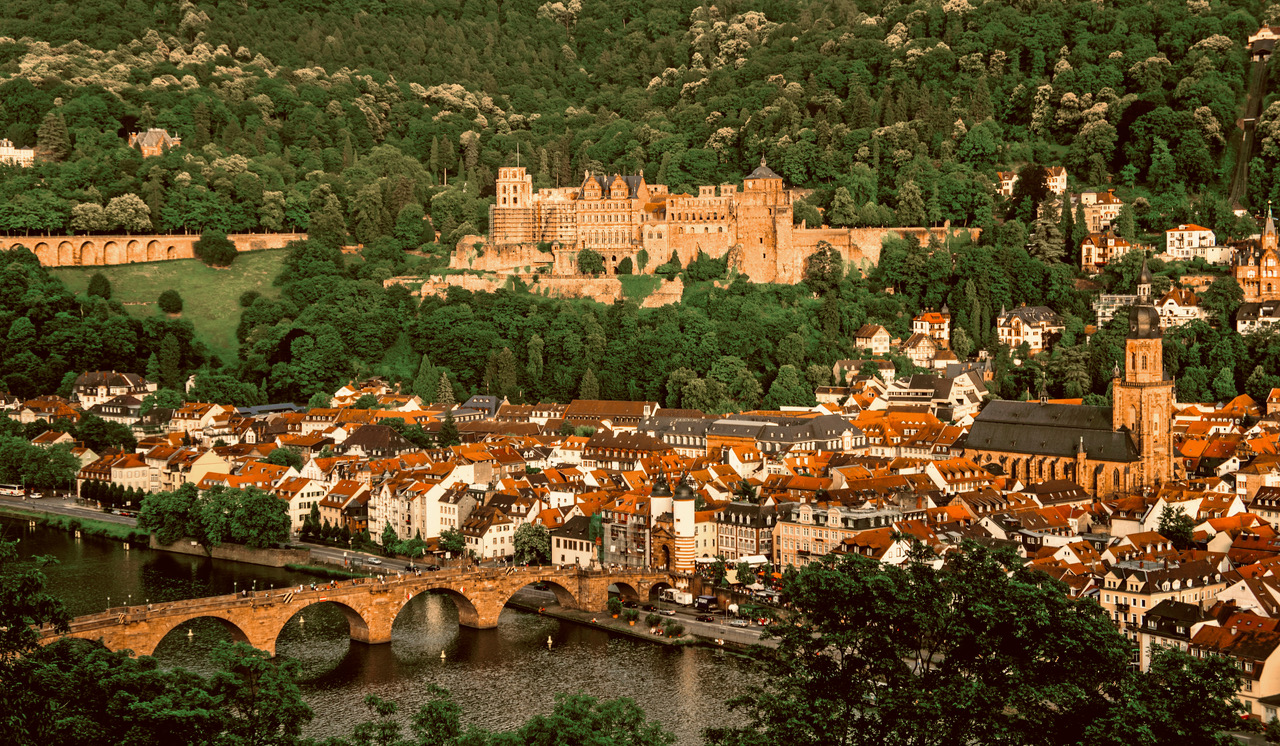
And suddenly Heidelberg itself began to take shape, like an image slowly emerging in a tray of photographic developer: the rusticated stone walls of the castle with their rows of windows, the church spires and turrets, the pastel-colored houses with their half-timbered façades, and even the alpine meadows, the forests and the mountain peaks with which my mind has chosen to embellish it still further.
Forgive me if the vision does not correspond exactly to the real geography. I have deliberately resisted comparing it with photographs. I preferred to let memory recover what my eyes at the time—divided between the summer of 1983 spent reading and the crisp air of my autumn as a student—had so stubbornly retained.
Heidelberg itself lay at the end of a short train journey, for my parents had found me lodgings with a strictly Catholic family in Ludwigshafen, a nearby industrial town on the Rhine. Herr and Frau W--- lived in a detached house with a garden, together with their two young children, the grandparents and a dog. I occupied the room of their eldest son, who was away at university.
Frau W--- was a beautiful, fair-haired woman who always spoke to me with an open, friendly face. Herr W---, by contrast, was an unassuming man and stood considerably shorter than his wife. He would take me with him in the car as he visited the building sites he supervised, so that I could practise my German, but he spoke very little, if anything. Every evening, precisely at six o'clock, all seven of us gathered round the table to spread butter and liver sausage on dark rye bread. Curled beneath Herr W---'s chair, the dog received the trimmings, the sausage skin, and the bits of gristle that he eventually extracted from between his teeth.
At night, when hunger woke me, I crept downstairs to the kitchen for more bread and butter, a little salami and a few pickles. My face was covered with spots within a matter of days.
On Sundays, after Mass, we would set off on excursions to take in the woods of the Palatinate ablaze with autumn color, and lunch would consist of plum dumplings or braised venison – also with plums. Herr and Frau W--- took my education to heart. They brought me to see Faust in the original German and to hear Mozart piano concertos in nearby Mannheim, where the composer himself had once stayed.
The rest I took care of myself.
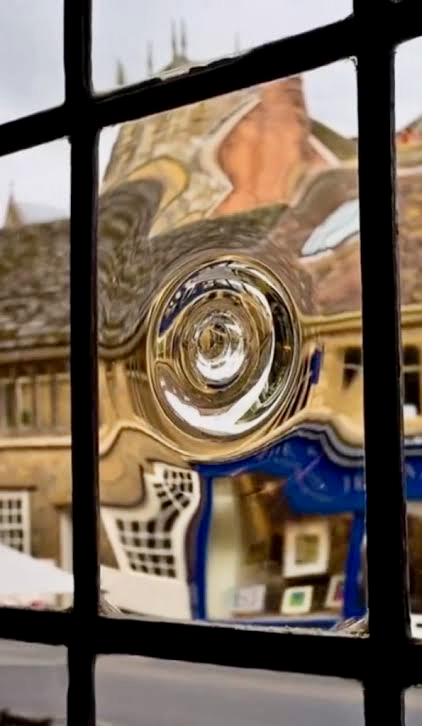
Every day I attended courses at Heidelberg University. A train ride brought me there in a matter of minutes. Heidelberg was another world altogether. I surrendered to its cobbled streets, its tall narrow houses painted in shades of yellow and blue, its leaded shop windows where small green and amber bottle-glass roundels caught the light and scattered it in concentric circles across the rooms within.
The places that drew me most were the bookshops and the music stores. I would spend hours browsing through scores and records, carefully choosing those I knew I would never be able to afford.
Since all my immediate needs were provided for, my father had entrusted me with only a very modest sum before I left home. Managing such a meagre budget required drastic decisions and constant renunciations.
Leaving the house so early each morning meant going without breakfast. The choice that confronted me was almost Kierkegaardian: buy the train ticket or surrender to the temptation of a generous breakfast. And so those eighteen minutes stretched endlessly before me as I watched the stations slip past through the narrow lavatory window, starting at every footstep outside the door of my hiding place.
At that hour the windows of the Bäckereien still held the warmth of the ovens. A secret geometry linked the architecture of the streets to my deepest cravings. I would gaze at the leaded panes, where the old circular pieces of glass distorted the light into liquid ripples; and just beyond them, displayed on baking trays, I found the same pattern repeated in the Zimtschnecken, the large cinnamon rolls for which I had such a weakness.
They were perfect spirals of soft, golden dough, their concentric design traced by dark amber veins of caramelized sugar and cinnamon. A drizzle of white icing—sometimes glossy and translucent like that old glass—had set between the coils, sealing within that perfect circle the warm, almost spicy fragrance that greeted me at the door and consoled my autumn as a poor student.

Yet the greatest lesson of those weeks was not one I paid for with the anxiety of travelling without a ticket, nor one I learned in the lecture halls.
There were afternoons when I climbed the Philosophenweg alone. Each time, the same view filled me with a kind of wild exultation. In the clear autumn air, the sky blazed with an even more vivid light. From up there my gaze swept across the sunlit plain below: the vast landscape glowed with a rich, warm gold, open to everyone.
Looking at the river and the towns fading into the distance, I felt that Philip Carey had been right to follow his own instincts.
So had I.
Without knowing it, I already carried the most precious coin in my pocket.
 ← Previous: Simply Water