Intro
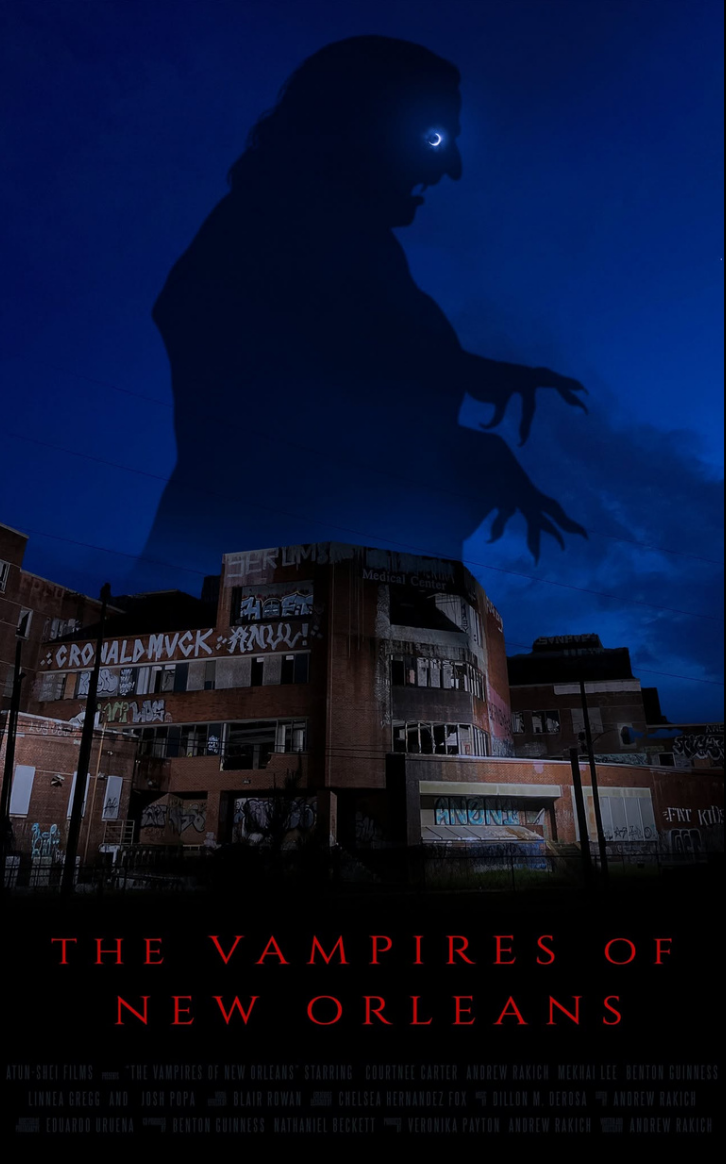
The Vampires of New Orleans is an upcoming docu-drama film, combining a documentary about New Orleans’ supernatural history, and a vampire-hunter revenge plot. It is written, directed, and stars Andrew Rakich, the founder and lead writer of the Atun-Shei Films YouTube channel/production company. The film was produced by Veronika Payton and Benton Guinness, scored by Dillon Derosa, shot by Eduardo Urueña, and features the makeup and special effects work of Chelsea Hernandez-Fox.
After an initial premiere on the 27th of September at the Broad Theater in New Orleans, and subsequent screenings in other local theaters, the film will release to pay-per-view on October 1st, on the Atun-Shei Films website, and later to its YouTube channel on Halloween, October 31st. Physical copies and pay-to-own digital releases are planned for 2027.
Something important to note: the film is structured in a unique way, such that the documentary and narrative portions are placed in between each other. It will spend around ten minutes with the documentary interviewees, and then show a few scenes of the film, and then back to the documentary, and repeat. It may sound like a strange approach, but it is essential to understanding the film, and is critical to its quality, so keep that in mind as you read this review.
Background – Artist Profile
Andrew Rakich started Atun-Shei Films in 2018 in an effort to educate viewers about American history via the medium of entertainment. Having worked as a living educator for the Gettysburg National Military Park and a walking tour guide for New Orleans, he started the channel in order to bring the fascinating and important parts of our nation’s history to as wide an audience as possible, “[endeavoring] to present public history in a cinematic and irreverent way”. While he has covered a wide range of topics and video styles, from short-form videos on local legends and history, to analysis and critique of historical films, or video essays about a wide variety of other historical topics, he found his greatest success in a series titled “Checkmate, Lincolnites!”, where a pair of Rakiches, dressed alternately in Confederate grey and Union blue, humorously debate and debunk the “Lost Cause” myths of the American Civil War.
With a strong subscriber base to support him after the end of “Checkmate, Lincolnites!”, Rakich began growing his style and technical prowess, collaborating with historians and other YouTube creators, until 2023, when he released his first feature film, The Sudbury Devil. Telling the story of two 17th-century Massachusetts witch-hunters, it made $50,000 on a $25,000 budget, and received moderate acclaim from critics. Vampires is Rakich’s sophomore directorial project, and shows off much of what he has learned from his first outing.
Documentary Summary
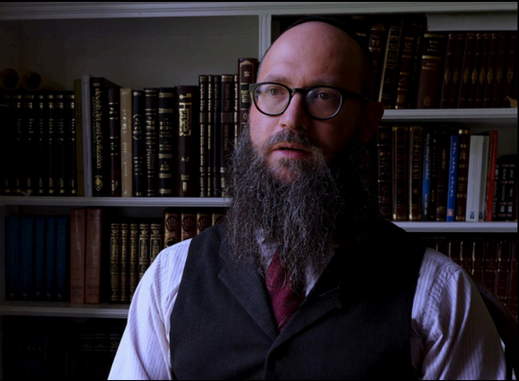
The documentary portions of the film are comprised entirely of interviews with a wide variety of those connected with the occult and the history of New Orleans. Subjects include local historians, activist groups, and many, many “ghost tour” tour guides, presumably contacts made from Rakich’s former job as a walking tour guide. The most interesting interviewees are a few people who self-identify as vampires, who claim to drink blood and the like, but these subjects are interviewed at the start and then disappear entirely, which disappointed me – I wanted to know more about them, and especially how they integrate themselves into “normal” society.
The documentary portions of the film begin by tracing the superstitions, misunderstandings, and grisly events that create the myth of the vampire, and then moves into discussing the local legends, including the “Axe Man” serial killer of 1918-1919. Opinions differ from tour guide to tour guide on how much of local history is true or not, but one thing is agreed on almost universally: the stories told are almost always “enhanced” by their tellers – it’s just good business.
After the ent’rance (intermission), the documentary portions shift in tone somewhat. While the interviewees still discuss ghost stories, they also start connecting them to the city’s history with slavery. Many of the victims of the local creatures of the night, whether the stories are exaggerated or complete fiction, are slaves, and the interviewees tell their stories. Finally, by the end, it disconnects entirely from the subject of vampires, discussing the roots of American slavery on plantations, and includes an interview with an activist about modern-day slavery (prison).
Movie Premise Summary
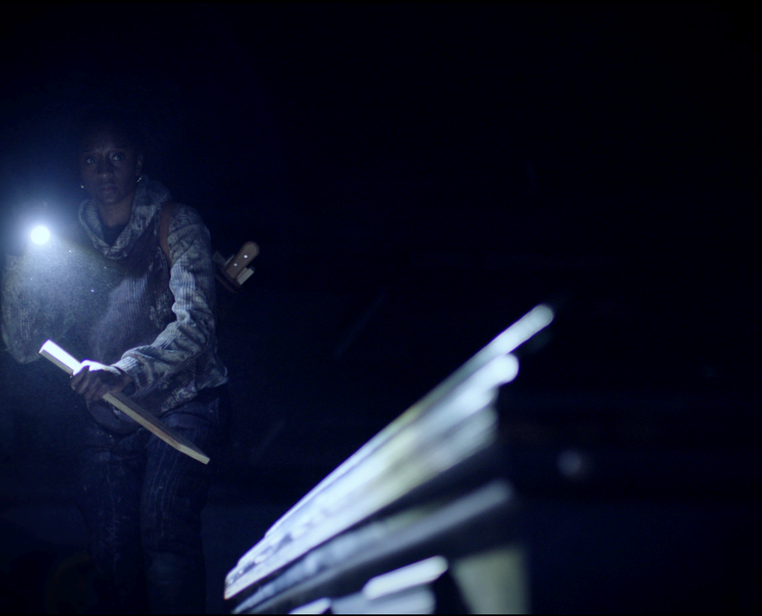
Given that this is a press preview, the director asked me to keep spoilers to a minimum, and as such, I cannot perform my usual walk-through of the film’s plot. I will instead provide a short summary of the first act’s events, to give context for the review and analysis. If you’re interested in seeing more, rent the film on October 1st to see what happens next.
A trio of vampires have invaded New Orleans. Plantation owner Jean-Louis D’Hemecourt (Andrew Rakich), Confederate widow Josephine Macarti (Linnea Gregg), and the historical serial killer Axeman (Carl Sailor) haunt the city with their human thrall, Nate (Benton Guinness). After local Shania Jackson (Kendra Unique) is murdered by D’Hemecourt, her sister, Brigitte (Courtnee Carter), her aunt Saffron (Monica R. Harris), and spirit-talker Dr. Tom (Mekhai Lee) team up to avenge Shania by putting an end to the set of bloodsuckers.
Review and Analysis
The technical aspects of the film are, for the most part, very well done. Of special note is the soundtrack. While it never rose to special attention during the film, the overture and intermission allowed a few minutes for it to receive the audience’s undivided attention, and, honestly, it rules. Strong, dramatic, and with many instruments, it fits the film perfectly and is worth a listen on its own. The cinematography is also of note for a job well done. While some daytime shots of the movie tend to look flat, amateurish, or otherwise cheap, the night and dark where most of the film takes place is rich and textured, with several standout sequences, like the multiple visits to the graveyard. The only technical complaint is a limitation expected of an indie film, namely the low-quality CGI.
The script and plot are what need the most work, but the problems within are mostly superficial that could be fixed with editing. For one, there is an entirely superfluous character and subplot that could be excised entirely with no great loss to the film. The scene does not further the plot, nor does it really provide characterization, and only seems to have been included to make bland commentary, and to have an “over-the-top” scene of blood and gore that the film fails to really pull off, again likely due to budget. Likewise, the Axeman vampire is more narrative device than character. Broadly speaking, the script is rather stock, but the actors were cast well for their roles, and help elevate it somewhat.
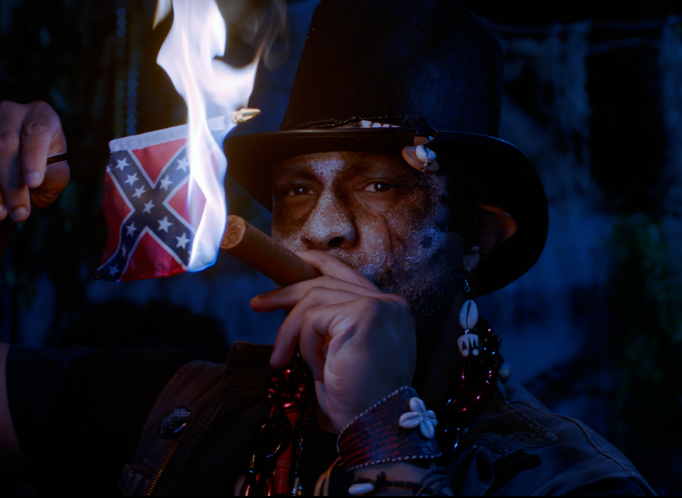
Now I will move on to more closely analyze the film’s message. We must remember, firstly, that documentaries are not neutral and even-handed, they are biased by what the director chooses to shoot, and what the editor chooses to put into the final product. These biases are not surprising, given Rakich’s previous work on YouTube, but he seems to be connecting vampires of folklore and legend to real life people and societal structures, using the Kuleshov effect to imply continuity between fact and fiction by the timing of transitions from documentary to film.
The comparison is most prominent during discussion of certain ghost stories native to New Orleans. The LaLaurie house receives a lot of attention; a wealthy widow, Delphine LaLaurie threw a child slave of hers from a window, and later was discovered to have tortured and mutilated several slaves within her home, forcing her into exile in France. While it is unclear how much of the story is sensationalized, the core elements are true, and when we cut back to the movie, we see Brigitte’s reaction to Shania’s murder, D’Hemecourt feasting on her in a gruesome fashion. This implies that, even if they did not feed on their slaves, the slavemasters of the south acted like vampires by the violence they inflicted upon them. The Kuleshov effect is used throughout the film as well; several times D’Hemecourt claims to never kill people, implying his many black victims are not people in his eyes. Then, by cutting back to the documentary talking about slaveowners of the past, it implies that the slaveholders of the past were vampires, in the metaphorical sense if not the literal one.
A more blunt communication of Vampires’ point is the extended interview with a prison activist. Noting that the 13th amendment still allows for slavery when used as a punishment, she describes its use at several prisons in Louisiana. Prisoners work in cotton fields with no tools, are whipped and driven by guards on horseback, or are rented out on lease to private and public firms: New Orleans’ state capitol building is at least partially staffed by enslaved prisoners. And, as an even more explicit recreation of plantation slavery, “Angola” (Louisiana State Penitentiary) has guards who live with their families inside the prison, with prisoner-servants catering to them. She says that many of the (mostly black) prisoners prefer to serve solitary confinement than relive their ancestors’ enslavement. This, to me, says that the prison system and its employees are modern-day vampires who draw enslaved labor from prisoners to enrich themselves.
Summary
The Vampires of New Orleans is an interesting project worth your time if you are a fan of Rakich’s other works, a fan of vampires, or a fan of American history in general. The script and plot are nothing to write home about, and the documentary would be rather anemic on its own, but the technical work and the uniquely-assembled structure elevate the two into a genuinely interesting product worthy of your time. Not for everyone, but then, what is?
Final Score – 7 out of 10.
 ← Previous: Dumpling Fest 2026